We have now come to one of the most unbelievable chapters of modern science. We are about to derive physical formulas without using any physical knowledge. We will only look at the units in which the physical quantities are expressed.
Let us suppose that we want to derive a formula for the physical quantity Q, which we presume to be dependent on the physical quantities R, S and T:
eq. 1
We will try to find a function of the form
eq. 2
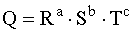
and choose a, b and c so that the equation holds in units. If we denote a "units of .." function with square brackets, we could write this down as:
eq. 3
We know the units of each of the quantities and we can therefore solve for a, b and c. If there is a unique solution, we have found our formula.
An Example
Let us derive the famous equation for the lift of an autogyro rotor. We will assume the lift to be dependent of the rotor shape (σ), the rotor angle-of-attack (α), the air density (ρ), the flying speed (v) and the rotor radius (R). We can write this down as:
eq. 4
Again, we want to find a solution in the form of equation 2:
eq. 5
This equation should also hold for the units (or dimensions) of the given quantities:
eq. 6
This leads to:
eq. 7
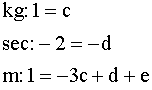
We see that a and b can not be determined, because they are dimensionless quantities. But we can solve for c, d and e:
eq. 8
This system has a solution of c=1, d=2 and e=2. By substitution back into equation 5, this yields:
eq. 9
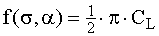
Where f is a dimensionless function of both σ and α. To get a nicer formula, we will introduce a coefficient of lift, defined as:
eq. 10
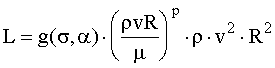
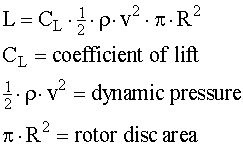
This brings us to the famous lift formula:
eq. 11
The dynamic pressure is measured by the so-called Pitot tube, that drives the speed indicator. This may look nice, but what we have done is merely transform one unknown quantity into another. We have transformed the unknown Lift into an unknown coefficient of lift. However, the derived formula is useful because of two things:
We can transform wind-tunnel results into real-flight results. As long as the coefficient of lift is the same (that is, both rotor shape and angle of attack are the same), the lift of the autogyro can be calculated from windtunnel results, even though the wind-tunnel speed and model size are different from the real flying speed and the real rotor size.
What if the solution is not unique?
In fact, we have already seen a situation where the solution was not unique. In the above example, a and b could not be determined and the solution was therefore not unique. However, we will look at another example to see what happens. Let us do the same anaysis, but also take the static viscosity of the air into account. Equation 6 now becomes:
eq. 12
or, if we work it out:
eq. 13
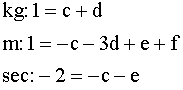
Again, a and b can not be determined. Equation 13 leads us to the following system, which has more more variables than equations:
eq. 14
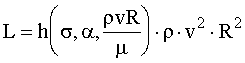
This system has a general solution of c=1-d, e=1+d and f=1+d. This result leads to the following lift formula:
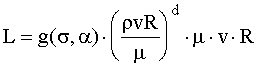
eq. 15
As d is undetermined, we could easily replace d by 1+p to get a better known lift formula:
eq. 16
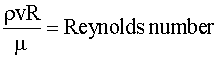
This is basically the same equation as equation 9, except for an extra factor which is a function of the Reynolds number:
eq. 17
In effect, we could write equation 16 as:
eq. 18
Again, we could define the coefficient of lift and end up with equation 11. The only difference is that we have shown that the coefficient of lift is also dependent on the Renolds number. If we had taken the speed of sound into account, we would have seen that the coefficient of lift is also dependent of the Mach number, which is the flying speed divided by the speed of sound.
Are these formulas physically correct?
Well, you don't know if you don't try. A dimension analysis does not contain any physical insights and the formulas derived with it should be tested. You can get as much nonsense out of the dimension analysis as you put into it. You could, for instance, take the mass density of the fuel instead of the air density. You would have ended up with the same formulas and fly with the heaviest fuel, because that would appear to give more lift. Anybody who has heared of the term "hot and high performance" would probably take the air temperature and the altitude into account and find that the lift is independent of the temperature, but does depend on h/R, the ratio of the altitude and the rotor radius. Remember that the air density is dependent on both the temperature and the altitude, so these effects were already taken into account. The ratio h/R is probably important if the size of the rotor approaches the size of the earth's atmosfere...
As you can imagine, the method is as good as the choice of the dependencies.

![[Q]=[R]^a*[S]^b*[T]^c](qdan03.gif)


![[L]=[sigma]^a*[alpha]^b*[rho]^c*[v]^d*[R]^e](qdan06.gif)


![[L]=[sigma]^a*[alpha]^b*[mu]^c*[rho]^d*[v]^e*[R]^f](qdan12.gif)