The "body parts" of an autogyro
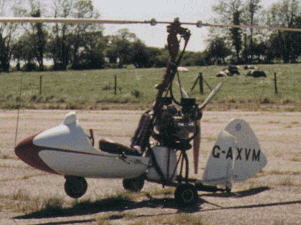 |
| A Crickett at Shipdham airfield |
Most autogyros (there are always exceptions) consist of the following "body-parts":
No exception to that. Every autogyro has a rotor that keeps it in the air. The rotor has two or more blades, which are attached to the axis with several hinges. These hinges prevent the aerodynamic moments that result from the forces on the blades to be transferred to the axis and the fuselage. To put it more clearly: The hinges form the difference between a rotorcraft rotor and a boomerang.
These hinges are so important that the invention of the hinges in rotors (by Juan de la Cierva) can be called the invention of all rotorcraft.
Flapping Hinges
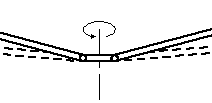 |
| flapping motion |
The most important of these hinges is the
flapping hinge. Flapping hinges allow the rotor blades to move up and down. As the advancing blade has more airspeed than the retreating blade, the advancing blade will produce more lift. Due to the gyroscopic effect of the rotor, the
front blade will go up. (Rotating things tend to react to forces a quarter of a cycle later...)
Lead-lag Hinges
 |
| lead-lag motion |
The
lead-lag hinge allows a blade to "run in" or "get behind" with respect to other blades. This is mainly to compensate for the extra rotational speed that comes with blade flapping. It also compensates for differences in blade drag in various moments of one cycle.
Let me explain the speed diffenrence that comes with blade flapping. Think of a ballet dancer making a pirouette with his arms stretched outwards. If he moves his arms closer to his body (that is, his axis of rotation), his rotational speed increases. This is the same with autogyro and helicopter blades. As they flap up or down, they come closer to the axis of rotation and they will speed up.
Feathering Hinges
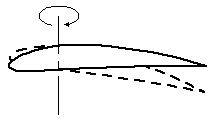 |
| feathering motion |
The
featering hinge makes it possible to change the pitch setting of a rotor blade. It is perfectly possible to build an autogyro rotor without feathering hinges, but you will need the feathering hinges during the spin-up if you do a jump start.
Changing the pitch setting of a rotor blade changes the lift on that blade and therefore influences the flapping angle of that blade. If you change the flapping angle periodically, such that the front blade moves down and the rear blade moves up, you tilt the rotor forward without tilting the rotor axis. Rotors that tilt by changing the blade pitch are called "
articulated rotors". Nowadays,
every helicopter rotor is an articulated rotor
Rotors that tilt by simply tilting the rotor axis are said to have "
direct axis control". The first autogiros by Juan de la Cierva all had direct axis control. Direct axis control is still very common with light autogyros.
It must be noted that present day autogyros and helicopters are fitted with far less hinges than described above. This is because the effect of the hinges can be achieved with other rotor constructions:
- Hingeless rotors have a flexible blade root, wich acts as a combination of all hinges. It is also called a "rotor with elastomeric hinges".
![[Download teetrot.jpg (6K)]](teetrot.jpg) |
Teetering rotor with
direct axis control |
The (always two-bladed) teetering rotor with direct axis control is a special case. It uses the fact opposing blades have opposing movements. It has therefore one central flapping hinge for the beam that forms the two blades. It uses the rotor shaft as a central lead-lag hinge. Feathering hinges are usually omitted on light and ultra-light autogyros.
Well, the rotor should be attached to something. It is funny to see that rotors with direct axis control are usually attached to a mast. For autogyros with articulated rotors, the rotor is generally attached to the cabin roof.
This has everything to do with weight. For ultralight autogyros, a load-bearing cabin would be far too heavy and the loads are therefore carried by a frame of beams. The vertical beam is called the mast, and carries the loads from the engine, the seats and the rotor.
For heavier types, a load-bearing cabin is a better alternative.
But that's not all. Most light autogyros are equipped with unarticulated rotors. These unarticulated rotors are always two-bladed, and two-blade rotors suffer from large periodic drag difference. This can be explained as follows: if one blade is pointing right and the other one left, the rotor catches more wind than in the situation that one blade is pointing forward and the other one aft. The flexibility of the mast allows the rotor to shift back and forth somewhat, eliminating large bending moments in the blade roots.
Rotors with more than two blades always have lead-lag hinges to prevent those bending moments and also suffer less from periodic drag difference.
 |
| Nose wings on the Walis WA-116 |
The fuselage is only meant to keep everything else together. Sometimes it has a nice shape to keep the drag at a moderate value and a windscreen to keep the pilot out of the free airstream.
In fast autogyros, keeping the drag at a moderate value is not only a matter of performance, but also a matter of control. With increasing airspeed, the fuselage drag increases more than the rotor drag and therefore the "center of drag" moves downward as you fly faster. To compensate for this effect, one Wallis WA-116 was fitted with canards.
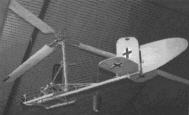 |
The Focke-Agelis
Fa330 Bachstelge |
The tail group will keep the fuselage going in the right direction. In most cases, it consists of a horizontal and a vertical surface
Vertical Surfaces
All autogyros need some vertical tail surface to stabilize the fuselage. Pusher type autogyros will need a rudder too, to compensate for some yawing effects. Especially when you make a landing flare, you are reminded of the fact that your propellor (which for some reasons was always free of hinges) is acting as a gyro. A gyro wants to do everything a quarter of a cycle later, so an increase in banking angle of the propeller will result in a yawing force on the fuselage. As the largest change in banking angle is likely to occur in a landing, you will be grateful if the designer of your autogyro has mounted the rudder in the propeller slipstream.
Funny enough, I've never heared of hinged tractor propellors, which would also solve this problem.
Horizontal Surfaces
Horizontal surfaces are not strictly necessary, because the gravitation will keep the fuselage hanging beneath the rotor. However, this is only true if other forces (except for the lift) are small with respect to the weight: that is when you are flying in a steady, slow flight.
If you are flying fast, the drag and the propulsion force can be large enough to bring the possibility of
pilot induced oscilation (See the Possible Problems chapter)
Notice that the tail group
stabilises the fuselage only. The rotor itself is quite stable and is not in any way stabilised (because of the hinges in the rotor) by the tail group.
You may ave wondered why the wheels of an autogyro are so far apart. That is because the undercarriage are not "just some wheels to stand on". The wheels also prevent the autogyro from falling over in case of rotor eccentricities. The undercarriage is always flexible to some amount, and this flexibility can interact with the rotor flexibility, which is built-in in the form of hinges (see
Ground Resonance in the Possible Problems chapter).
In the case of an autogyro with a jump starter, it is also the anti-torque device and must have a firm grip on the ground. It helps if the rotor pushes the autogyro downward during the spin-up phase of a jump start.
Autogyros with jet engines have existed, but most autogyros are simply too small to make a jet engine effective. So you will generally find autogyros with propellor engines, and most of them are pushers.
During the start, the engine can drive the rotor on most autogyros. This "pre-spin device" is either called a prerotator or a jumpstarter, depending of the type of start it was designed for.
A prerotator just helps the rotor spin up before the actual take-off run. A prerotator does not give the rotor enough energy for take off, but just shortens the take-off run.
A jumpstarter is meant to give the rotor enough energy for a vertical start, usually 1 1/2 times the normal flight rpm. As soon as the rotor is uncoupled from the engine, the pilot pulls the collective (or this is done automatically) and the autogyro "jumps" in the air. Once airborne, the pilot should gain forward speed immediately.
Back to the table of contents